English
 Français
 Deutsch
 Suomi
Suomi Español
Enontekiö's central wilderness areas are Pöyrisjärvi (1,280 sq. km), Tarvantovaara (670 sq. km) and Pulju (614 sq. km), all established in 1991. NB: some websites refer to the Enontekiö Highland Watershed Area for hiking trails; this is essentially just a combination of the Pöyrisjärvi and Käsivarsi areas, so don't get confused! Outdoors.fi has details on access points by car and public transport, the relevant maps, and each area's history and nature.
- Pöyrisjärvi Wilderness Area: 1,280 sq. km, established 1991
- Tarvantovaara Wilderness Area: 670 sq. km, established 1991
- Pulju Wilderness Area: 614 sq. km, established 1991 - c. 40km from Hetta
- For experienced, self-sufficient hikers - mostly no marked trails; carry map and compass
- Angling and ice fishing are Everyman's Rights (with national fee + area permit for rivers)
- Struve Geodetic Arc UNESCO point atop Stuorrahanoaivi in Tarvantovaara
Pöyrisjärvi Wilderness Area
Pöyrisjärvi (1,280 sq. km) is a wonderful destination for experienced hikers with the right equipment and supplies. It takes its name from Lake Pöyrisjärvi in the north of the area, where impressive sand dunes and ridges rise. We say 'experienced' because there are no marked trails and, while the rolling fell and forest makes wonderful hiking terrain, the large bogs are best circled - so you need to navigate reasonably well.
That said, many old unmarked trails crisscross the landscape, as Pöyrisjärvi has always been an important fishing, hunting and reindeer husbandry area. The Lapp villages of Kalkujärvi and Pöyrisjärvi lie within it and are still inhabited for part of the year. There are great possibilities for canoeing, fishing and mountain biking - the two largest rivers, the Pöyrisjoki and the Käkkälöjoki, are especially good for canoeing and fishing.
The area is nestled among several other protected areas: the Saaravuoma-Kuoskisenvuoma Mire Reserve to the south, Pulju Wilderness Area and Lemmenjoki National Park to the east and south-east, and Övre Anarjokka National Park over the border in Norway. It is most easily reached by car (e.g. from Näkkälä, Vuontisjärvi or Kalmakaltio), or you can start straight from Hetta and connect to Näkkälä via the designated hiking and snowmobile trails.
What to do at Pöyrisjärvi
Walk: There are no marked hiking trails within the wilderness area, but there are many old well-worn paths used as a postal route at the beginning of the 20th Century. A marked trail passes just outside the boundary.
Canoe and row: The River Pöyrisjoki (source at Lake Pöyrisjärvi) and the River Käkkälöjoki are both excellent canoeing routes.
Fish: Angling and ice fishing are Everyman's Rights here, so no permit is needed for those (worm-bait angling and ice fishing are forbidden in flowing waters). To fish the rivers you need the national fishing management fee plus an Enontekiö 1551 permit; lure fishing the lakes needs a provincial lure fishing permit. Common catches include whitefish, pike, perch, burbot, grayling and trout. Lake Pöyrisjärvi's dominant species is whitefish, 200-300 grams per fish.
Cycle, ski, hunt and pick: Paths can be used for demanding mountain biking (carry map and compass). Skiing is permitted all over the area, but there are no maintained trails. Hunting needs permit 1615 Näkkälä or 1616 Nunnanen. The cloudberry is the most popular berry, in late summer / early autumn, with blueberries and lingonberries in the south and abundant mushrooms in the forests.
Pöyrisjärvi history and natural features
Many prehistoric artefacts have been found here - settlements, hole-traps and seitas (places of worship) from the Stone Age and early Metal Age, mostly around Lake Pöyrisjärvi. So far 19 hole-trap sites have been found; these were used for hunting wild fell reindeer. Fishing and hunting were for centuries the most important sources of livelihood. Before the Finland-Norway border was closed in 1852, Sami from the Kautokeino area herded reindeer here.
The landscape changes from dry pine forests on the south boundary, through birch, to treeless fell tops north of Lake Pöyrisjärvi. The sand dunes are one of the area's most interesting sights, with most on the north side of the lake. Pöyrisvuoma is one of the largest mires in Enontekiö and one of Finland's most valuable palsa bogs, with around 50 frost mounds. The rarest mammal is the Arctic fox, and the most bird-rich areas are the mires, where 21 of Finland's 29 wader species are present.
Tarvantovaara Wilderness Area
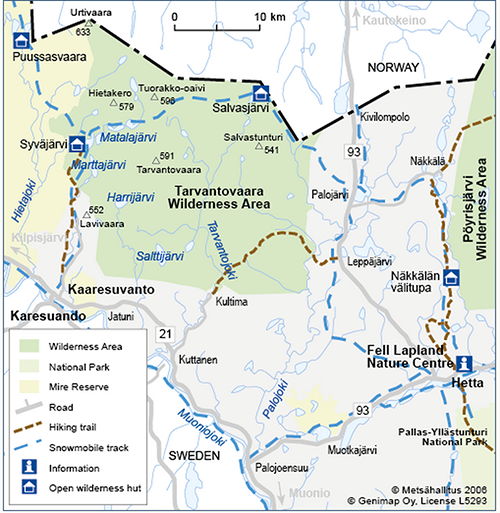
Tarvantovaara (670 sq. km) is a perfect retreat for experienced hikers seeking peace, quiet and unforgettable nature. Together with the bordering Lätäseno-Hietajoki Mire Reserve it has an extremely diverse bird population. The famous Finnish nature writer Yrjö Kokko spotted his first Whooper Swan's nests by a lake in these fells, inspiring his 1950 book about the swan - after which it was declared protected; today they nest here in large numbers.
The area lies west of Leppäjärvi and north of Kaaresuvanto, its northern boundary following the Finnish-Norwegian border. Fell tundra rises near the Norwegian border, the highest peaks over 600m. Forests are mainly fell birch and about a third of the area is mire, mainly palsa bogs.
What to do: Two marked trails - the Kultima-Leppäjärvi Trail and the Kaaresuvanto-Syväjärvi Trail - are maintained and marked with kilometre posts; always carry map and compass. The Rivers Palojoki and Tarvantojoki are good spots for beginner canoeists. The area is a wonderful bird-watching destination. Mountain biking is permitted on the trails, and the Hetta-Kilpisjärvi snowmobile track runs through the area via Palojärvi.
The Struve Arc: At the top of Stuorrahanoaivi sits one of six points in Finland of the Struve Geodetic Arc, a UNESCO World Heritage Site. First marked in 1850, the point is engraved in stone with a cross. The German-born astronomer Friedrich Georg Wilhelm Struve used his survey triangulations to help determine the shape and size of the Earth in the 1800s.
Pulju Wilderness Area
Pulju (614 sq. km), c. 40km from Hetta, is known for its large mires and numerous hills and fells. It is a perfect destination for experienced trekkers, and its abundant late-summer cloudberry crop attracts day-trippers. A fairly large road (with a snowmobile track) runs through the centre from Nunnanen to Pulju, making it convenient to reach. It is bordered by Lemmenjoki National Park to the east and Pöyrisjärvi Wilderness Area to the northwest.
There are no marked trails, but some clearly visible old tracks. One c. 10km track leads from Kalmakaltio Spring towards Lake Pahtajärvi in Lemmenjoki National Park (drawn on the Lemmenjoki 1:50,000 map). You can canoe from Lake Korsajärvi into the head waters of the River Ivalojoki. Angling and ice fishing are Everyman's Rights, with the relevant national fee and Enontekiö 1551 (or, on the Kittilä side, 1401) permits required. The road through the area makes berry-picking easy, with plenty of cloudberries, blueberries and lingonberries in good years. A snowmobile track between Nunnanen and Pulju links on to Levi, Kittilä and Hetta. Puljutunturi Fell in the south rises to 471m.