English
 Français
 Deutsch
 Suomi
Suomi Español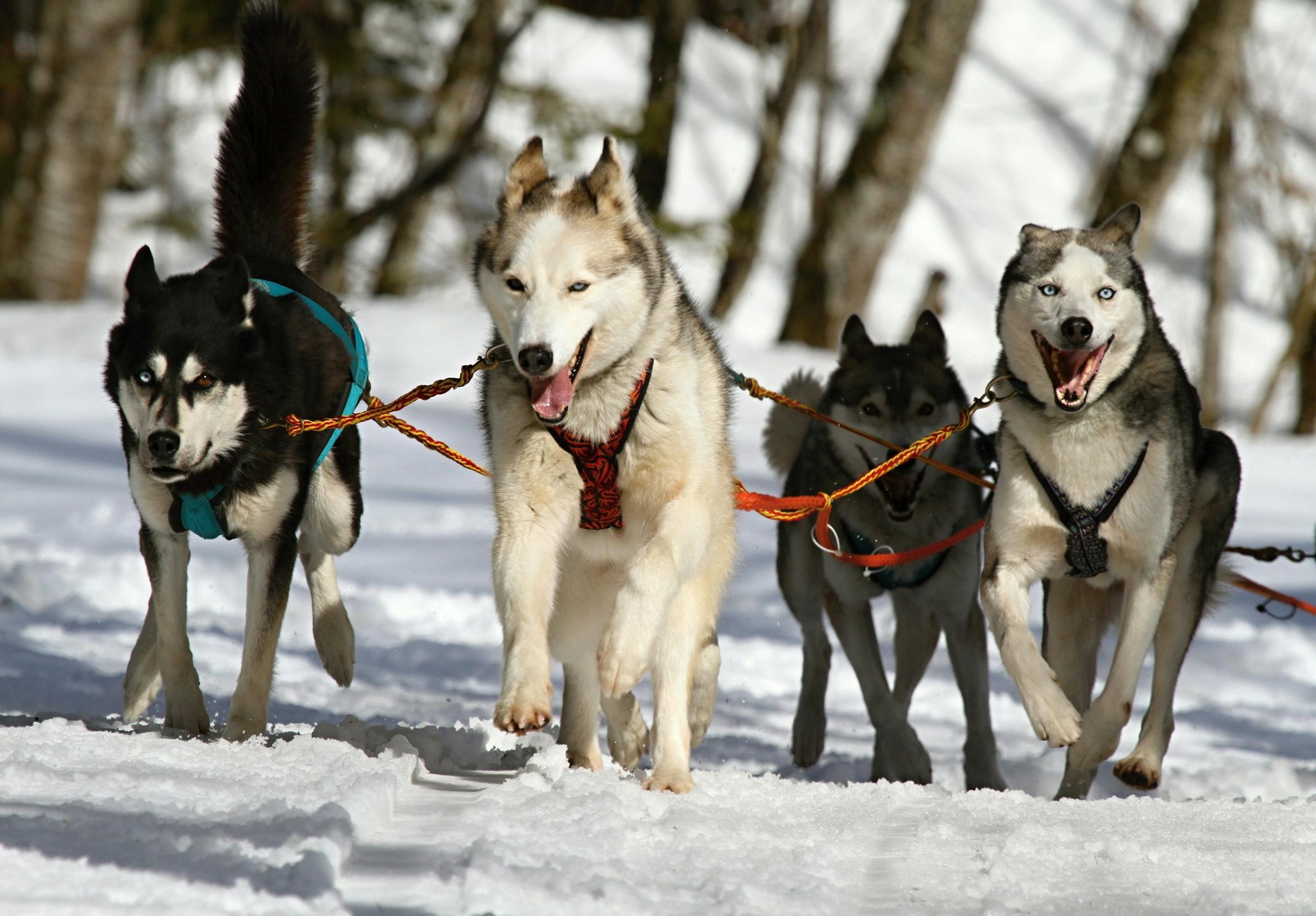
Eurohounds, Alaskan Huskies, Siberian Huskies and Malamutes are sometimes confused, but all can fairly be called sleddogs - they are simply good at slightly different things. Most people picture the Hollywood 'sleddog': a large fluffy Malamute or a big blue-eyed Siberian. In reality the vast majority of safari companies use so-called 'Alaskan' huskies, which may look quite different, and most racing huskies are either Alaskans or Eurohounds.
- Most safari and racing dogs are Alaskan Huskies or Eurohounds, not the Hollywood ideal
- Only ~20% of huskies have blue eyes; another ~20% have mixed-colour eyes
- Siberians have thicker coats - best for long safaris and sleeping outdoors
- Alaskans are faster and happy to repeat loops, but need coats and more food in the cold
- Taimyrs are long-furred Russian pure-breds, strong yet docile (up to ~45kg)
- Nenet-Laika-Taimyr crosses are former reindeer-herding dogs (~25-35kg)
A wide range of breeds and types
At Hetta Huskies we are glad to keep a wide range of breeds and types, even if most are 'so-called' Alaskan Huskies, because we offer a wide range of tours. Visitors love photos with the picture-perfect Siberians, Taimyrs or Malamutes while also enjoying the speed of the faster Alaskans. Some of our Alaskans could easily pass for typical Siberians - and we have a few true Siberians, plus a few Malamutes (one, Tala, a rescue). A few dogs are more 'Eurohound-like', having come from sprint farms: great for faster, shorter tours, but needing special care in colder temperatures.
The Alaskan Husky
The Alaskan Husky is a mixed-breed sled dog defined by its job and performance, not its appearance, and is not recognised by any kennel club. They are usually leaner than Siberians with a more pronounced tuck-up. Both can have the Hollywood blue or blue/brown eyes, though in reality only about 20% of huskies have blue eyes and a further 20% mixed-colour eyes. Alaskans tend to run faster than Siberians, at least over shorter distances, and don't mind repeating the same loops with tourists thanks to their very strong desire to run.
Siberians, Malamutes and coats
Siberians have thicker fur than Alaskans, many of which have been bred for racing with more 'hound-like' coats. Siberians therefore withstand colder temperatures and suit longer safaris where they may sleep outdoors without shelter; durable, steady endurance athletes, they can nonetheless get bored repeating a short loop. Skinnier, thinner-coated Alaskans must eat more to stay warm, often sharing a kennel and wearing coats between loops. Malamutes are less common in the safari world, being less suited to short safaris and a little more aggressive - 'but they are very pretty!'
Taimyrs and Laika crosses (the 'fluffies')
We have two distinct groups of so-called 'fluffies' that need much more brushing than our other dogs. One litter are Taimyrs - a pure breed from Russia (eg KGB & Patapov) traditionally bred by the Nganasans of Siberia, whose thick fleece was prized for making clothes. The Taimyr is long-furred, more athletic than its size suggests (45kg is not uncommon), and arguably the strongest yet most docile of the sled dogs - loving, sociable and obedient, ideal expedition dogs. The other group are Nenet-Laika-Taimyr crosses (eg Nakat/Tog), originally reindeer-herding dogs of the Nenets, intelligent and fiery with great stamina, weighing 25-35kg with thick, often matted coats.