English
 Français
 Deutsch
 Suomi
Suomi Español
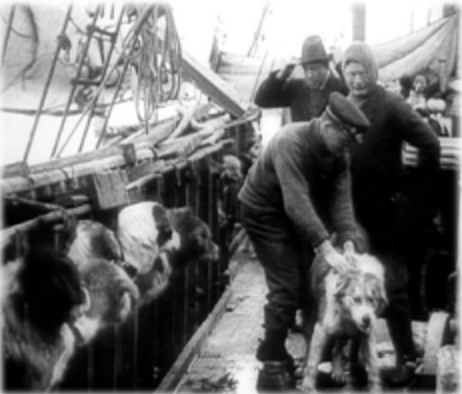
Early attempts to use dogs in exploration were generally unsuccessful, since explorers rarely had experience handling them - Parry, Lyon, Ross and Kane all reverted to man-hauling. John Rae of the Hudson's Bay Company adopted a more pragmatic land-based approach using fewer than 10 people, dog sleds and techniques learned from the Inuit. Dogs first arrived in Antarctica on 17th February 1899 and the last were taken out on 22nd February 1994, after the Antarctic Treaty required non-native species to be removed.
- Dogs in Antarctica: 17 Feb 1899 to 22 Feb 1994 (banned by the Antarctic Treaty)
- Amundsen reached the South Pole first (1911), 35 days ahead of Scott
- Amundsen set off with 52 dogs and returned with 11
- Optimal BAS sledge dog: ~23in at shoulder, ~90 lb; useful working life ~7-8 years
- Wally Herbert's 1968-69 Arctic crossing: 3,800 miles, 16 months, 40 dogs
- Boyarsky's 1989-90 crossing: 6,500 km in 7 months
Nansen and Amundsen
Nansen used Greenland dogs on his famous voyage across the Arctic Ocean in the Fram. Amundsen first opened the Northwest Passage (1903-06), learning dog sledding and Arctic survival from the Netsilik people. He then planned his South Pole expedition meticulously around 97 Greenland dogs, skis and Eskimo-style clothing. In 1911 his team of five became the first to reach the South Pole, 35 days ahead of Scott, and all returned in good condition - having even gained weight. He set off with 52 dogs and returned with 11, the rest deliberately used as food for men and dogs alike. Helge was the dog killed at the Pole itself.
Mawson
The eleven dogs that returned with Amundsen from the Pole were given to Douglas Mawson's Australasian Antarctic Expedition (1911-14). Mawson's three-man sledging team suffered disaster when Ninnis fell through a crevasse with six dogs and most of the rations. On the return, Mertz died and the remaining dogs were killed one by one to save Mawson's life - the dog livers unwittingly poisoning Mertz with vitamin A. Mawson continued alone, cutting his sled in half and dragging it 160km back to Cape Denison, arriving to the words: 'My God, which one are you?'
Peary, Scott and Shackleton
Peary, like Amundsen, learned from Native Peoples and used sled dogs and Eskimo guides on his contested 1908-09 North Pole attempt (133 dogs, 19 sleds, 23 men). Scott, by contrast, took just 33 SE-Siberian dogs alongside ponies and tractors, intending to revert to man-hauling - and his party of five perished on the return from the Pole. Shackleton's Imperial Trans-Antarctic (Endurance) Expedition of 1914-17 became an epic of survival after his ship was crushed; the dogs hauled men, lifeboats and stores across the Weddell Sea ice, but had to be shot when they could not be taken in the lifeboats. Frank Wild recorded: 'I have known many men who I would rather have shot, than these dogs.'
The Scientific Age
In the Scientific Age, dog handling was studied carefully. A Cambridge dog physiologist at the British Antarctic Survey found a smaller, sturdier dog could out-pull a heavier one, and defined an 'optimal' sledge dog of about 23in at the shoulder and 90lb. A team of around nine, often led by a bitch, might average 16 miles a day on the Peninsula. Food needs were ~2,500 kcal a day when idle and 5,000+ kcal when hauling, with seal meat and blubber the best diet. Occupational osteoarthritis limited a sledge dog's useful working life to about 7-8 years.
Fuchs, Herbert, Fiennes and Boyarsky
Vivian Fuchs led the first crossing of Antarctica via the South Pole (1955-58) by Sno-Cat, but earlier made major journeys with his lead dog Darkie. Wally Herbert made the first surface crossing of the Arctic Ocean in 1968-69 - a 3,800-mile, 16-month trek with three companions and forty dogs, hailed as 'the last great journey on Earth'. Ranulph Fiennes circumnavigated the globe on its polar axis with the Transglobe Expedition (1979-82), accompanied by his Jack Russell Bothie. Victor Boyarsky crossed the entire continent of Antarctica (6,500km in 7 months) on the 1989-90 International Trans-Antarctica dogsled expedition, one of the last great projects with dogs on that landmass.