English
 Français
 Deutsch
 Suomi
Suomi Español
Luckily the best season for ski-mountaineering falls outside our peak husky season. So if you want to ski-mountaineer in popular arctic destinations like the Lyngen Alps, we can advise, arrange guides or guide you ourselves.
Northern Scandinavia offers limitless ski and mountain possibilities. The terrain ranges from the white snow deserts of Lapland to the incredible sea, snow and mountains of Norway's coasts, plus the endless labyrinth of peaks and glaciers in Spitzbergen. In these vast wildernesses there is something for everyone to climb or ski, from wide easy snowfields to narrow ridges and challenging steep couloirs.
- Guided ski-mountaineering, heli-skiing, free-skiing and kite-skiing across the North
- Ski Mountaineering Course: Lyngen Alps, Feb–May, 5 days, 3–8 people, €525 pp
- Jiehkkevárri (1834 m) day tour, the 'Mont Blanc of the North': €120 pp
- Ski-Mountaineering / Free-skiing Day: 1 day, 1–5 people, €360 per group
- Kite-skiing day: Kilpisjärvi or Hetta, 5 hours, 1–4 people, €100
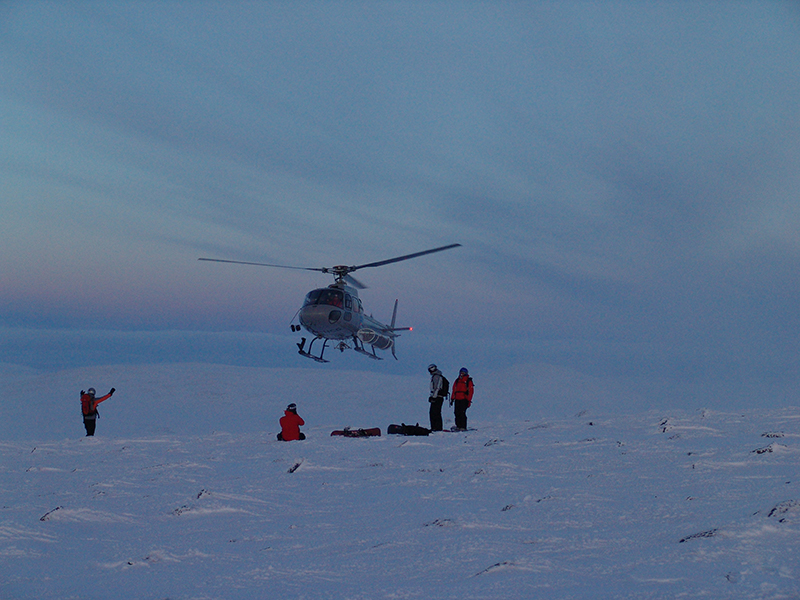
- Heli-skiing by request: ~3000–5000 m vertical descent per day
- Snow-safety and glacier gear included in the price of all products
Ski-Mountaineering & Free-skiing
The common factor across all our options - heli-skiing, ski & boat journeys, ski touring or snowmobile & ski trips - is superb skiing in the breathtaking nature of the North. In Finland we guide on the routes around Hetta, in the Käsivarsi region of Kilpisjärvi and in Lapland's various ski centres.
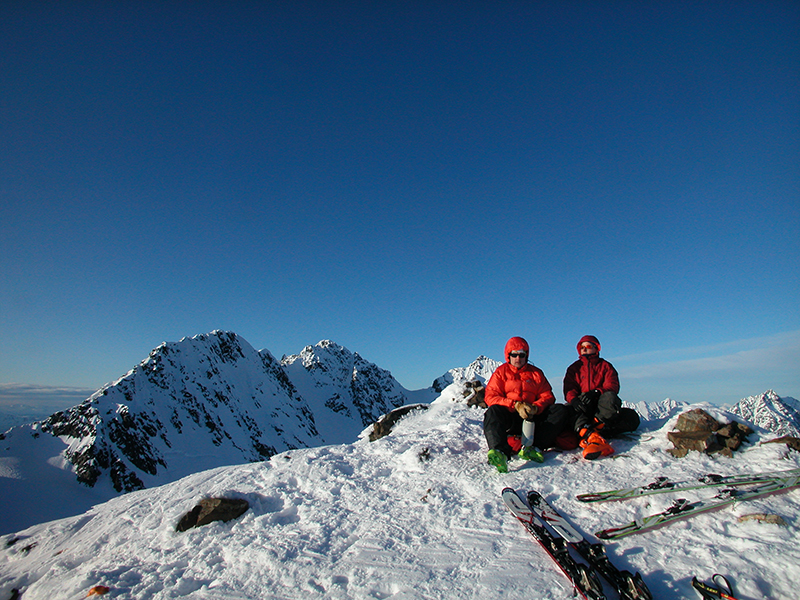
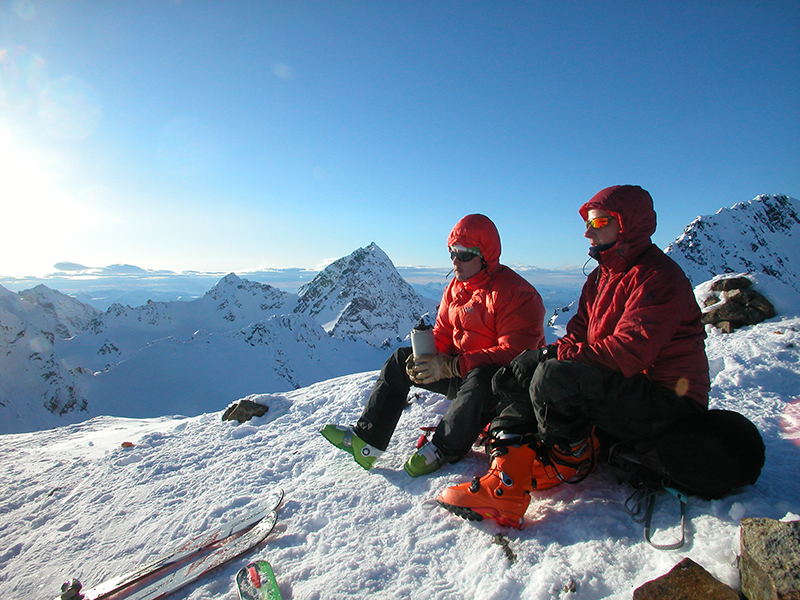
Ski mountaineering means challenging ascents on foot, with crampons or snowshoes, and descents by ski. We always select routes to make the descents as rewarding as possible within the group's skill level, and our ski-mountaineering courses include ascent options and some climbing instruction as appropriate. Free-skiing products put the emphasis firmly on the descent.
Equipment
In the winter mountains you need the right equipment and the knowledge to use it safely. At a minimum, alongside standard mountain-safety gear like headlamps and duvet jackets, all back-country skiers, boarders and mountaineers in the Scandinavian mountains should carry snow-safety gear (avalanche transceivers, shovels and probes).
This specialist kit, and a rucksack for it, is included in the price of our products, though you are welcome to use your own, and every ski day starts with a safety-equipment briefing. You will need your own ski-mountaineering equipment, or normal skis with binding adapters or telemark skis with skins; snowboarders ascend on snowshoes. We always recommend helmets and back-armour, plus knee protection for telemark skiers. Any additional specialist kit can be hired from us.
Ski-Mountaineering in Arctic Norway: Lyngen & Tromsø
In Norway we guide in Lyngen, Tromsø and, occasionally, the Narvik / Lofoten area. Lyngen's enormous mountainous peninsula, set between two fjords, lies c. 50 km east of Tromsø and 50 km west of Kilpisjärvi. So spectacular and Alpine is it that mountaineers call it the 'Lyngen Alps': mountains and glaciers rise straight from the sea to around 1500 m, and the highest summit, Jiehkkevárri (1834 m), is known as the 'Mont Blanc of the North'.
Tromsø, 'Ishavsby', is a vibrant city of 65,000 right beside the Arctic Ocean and surrounded by mountains and fjords. Plentiful snow and its northerly location allow skiing through to mid/late June, with the best conditions usually in March, April and May. It is everything an outdoor person could wish for as a base for an active holiday.
Heli-skiing in Arctic Sweden
In Sweden we offer courses in Riksgränsen, plus products in Svalbard (Spitsbergen). The ski season in this part of Lapland is long and guaranteed: last winter the heli-ski season started in January and we did our last runs with clients in June. Snow depth passes 1 m by the end of February, with fresh powder as late as mid-May.
We offer heli-skiing by request only, tailor-making each package to the client. Our typical helicopter carries the pilot, guide and four skiers, so it is most economical to ski as a group of four. A typical heli-ski day gives 4–6 hours of helicopter use and about 1–1½ hours of flying time, meaning 5–10 lifts and some 3000–5000 m of vertical descent.
Kite-skiing
Lapland has a number of kite-skiing destinations that are a kite-skier's paradise, but it is best to learn this unique sport on flat icy lakes. Our most popular starting places are Kilpisjärvi's Kilpis Lake and the Ounas Lakes of Hetta. Once more advanced, you can kite-ski in the fells on a day trip or longer, most choosing the treeless Käsivarsi wilderness area ('Finland's arm') or the Pallas-Ounas mountain chain, where with adequate wind you can easily cover tens of kilometres a day. You will need your downhill, telemark or snowboarding equipment and a helmet; Arctic Mountain Guides uses Ozone kites and equipment.