English
 Français
 Deutsch
 Suomi
Suomi Español
The hiking trails in this region are probably some of the best in the world, with state-maintained wilderness cabins on almost every route. The mountains blossom throughout July and August and hiking is possible from mid June to the end of September. This section is subdivided into Enontekiö's great wilderness areas and the Kilpisjärvi region.
- Four great wilderness areas: Pöyrisjärvi, Pulju (614 sq km), Tarvantovaara (670 sq km) and Käsivarsi (2,206 sq km)
- Halti, Finland's highest fell, reaches 1324m near the Norwegian border
- Nordkalottleden Trail is 800km in total (70km in Finland) with 40 wilderness huts
- Three Nations' Border Stone marks the Finland–Sweden–Norway point in Malla Strict Nature Reserve
- Demanding wilderness hiking for experienced trekkers; always carry map, compass and overnight gear
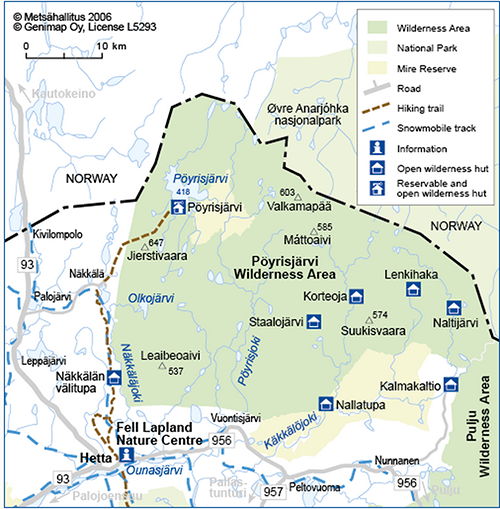
Hiking in the Pöyrisjärvi Wilderness Area
The rolling fell and forest landscapes of Pöyrisjärvi Wilderness Area make wonderful hiking terrain, though the large bogs are best circled. There are no marked trails, but many old unmarked ones – most visible on terrain maps – as Pöyrisjärvi has always been an important fishing, hunting and reindeer husbandry area for locals. Everyman's Rights apply here.
The Hetta-Näkkälä Marked Trail (26km) follows an old postal route, marked with tall green poles topped by a white-red cross. The unmarked Kalmakaltio-Pöyrisjärvi-Näkkälä Trail (~93km) is extremely demanding, crossing the middle of the wilderness with rivers that must be waded. Always carry a map, compass and proper overnight gear; the weather can change very quickly and it can snow even in summer.
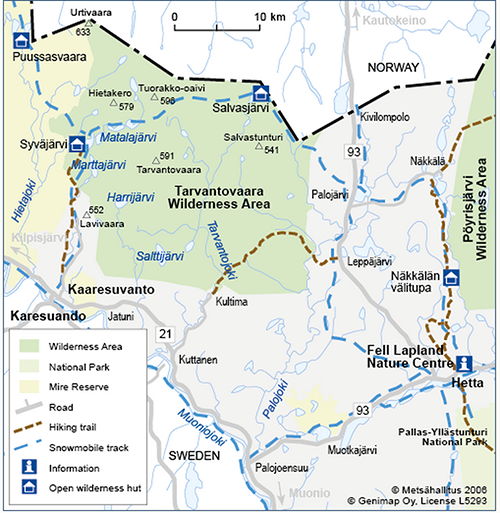
Pulju & Tarvantovaara Wilderness Areas
Pulju Wilderness Area (614 sq km, established 1991), known for its large mires and numerous hills and fells, is a perfect destination for experienced trekkers, and its abundant late-summer cloudberry crop draws day-trippers. A road and snowmobile track run through it from Nunnanen to Pulju, and reindeer husbandry is a significant livelihood here.
Tarvantovaara Wilderness Area (670 sq km, established 1991) is a peaceful retreat for experienced hikers, where Whooper Swans nest in large numbers among a diverse bird population. Trails include the Kultima-Leppäjärvi Trail (25km), a good day-trip route also suitable for mountain biking, and the Palojärvi-Salvasjärvi Trail (20km), an old postal track that briefly crosses into Norway.
Hiking in the Kilpisjärvi Region
Kilpisjärvi is the main village in the arm of Finland and the chief starting point for hikes in the Käsivarsi Wilderness Area and the Malla Strict Nature Reserve. Saana (1029m), visible from all corners of the area, is said to be Finland's best known fell. Scrambling to its top is a challenge worth doing – the longest set of stairs in Finland (two kilometres of solid wooden steps with lookout platforms) helps at the steepest part.
Trails of note include the Iitto Nature Trail (500m) across rare palsa moors, the Saana Trail (8km), and the Malla Nature Reserve trail to the Three Nations' Border Stone (11km), where the borders of Finland, Sweden and Norway meet on a man-made island. Malla, established in 1916, is Finland's oldest nature conservation area.
Käsivarsi Wilderness Area & the Nordkalottleden Trail
Käsivarsi is Finland's second largest wilderness area (2,206 sq km, established 1991), in the NW corner of Enontekiö. Other than Saana, all of Finland's fells over 1000m are here. One marked trail leads through it: the Kalottireitti / Nordkalottleden (Calotte Route).
The full Nordkalottleden Trail is 800km long – 70km in Finland, plus 380km in Norway and 350km in Sweden. Its most popular Finnish part runs between Kilpisjärvi and Halti, Finland's highest fell at 1324m. Forty wilderness huts line the whole trail, with hikes between them of 10 to 50km. It is demanding and not for beginners; the best time for the Finnish section is early July to mid September. Allow about a week for the Kilpisjärvi – Halti – Kilpisjärvi loop (c. 108km).