
 English
 Français
 Deutsch
 Suomi
Suomi Español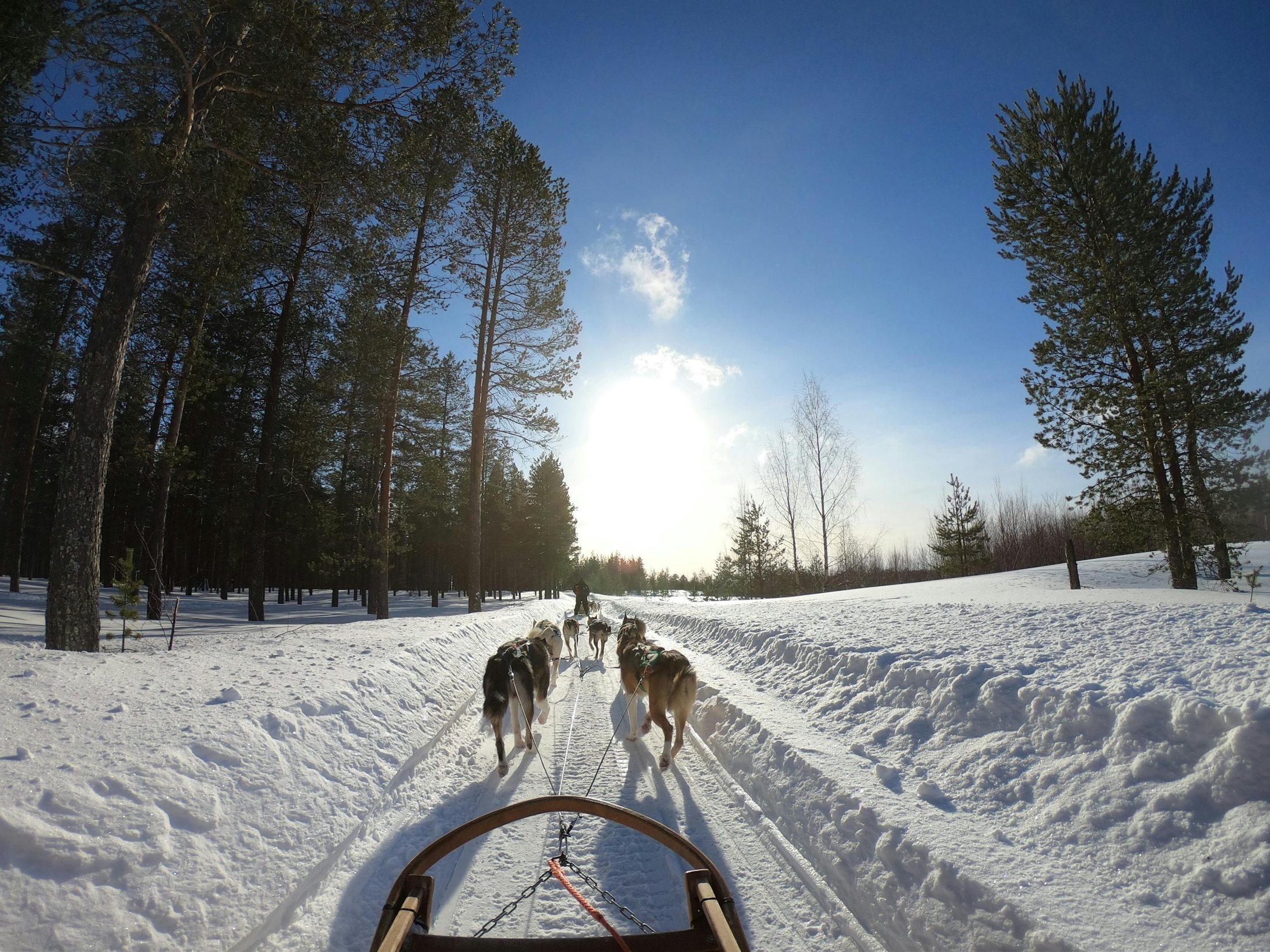
Here are some basic tips for driving dogsleds for the first time. When it is time for your safari, be assured that our guides always go through everything that you need to know before you start — including a safe start, secure turns, speed control and stopping, as well as 'counterbalancing' the sleigh, ascending and descending. Those joining us for longer safaris can also learn how (and why) to supervise the teams during breaks.
- Keep both hands on the handlebar and don't let go
- Leave a 10m gap to the team in front
- Lean into turns; brake before, balance through
- Counterbalance onto the opposite runner if the sled tips
- Help the dogs uphill; ride the brake gently downhill
- Passengers stay seated, hands and legs inside the sledge
Starting point
Starts are high-adrenaline moments for huskies and mushers alike; the atmosphere can be electric. At rest the sleds are tied to an immovable object such as a holding post or tree. We help passengers settle on their reindeer skins with blankets tucked in, then you wait with two feet on the brake and both hands firmly on the handlebars until all the teams are ready.
Keep your hands firmly on the handlebar at all times. (Nearly every day a client relaxes half-way round, reaches for a camera or loses grip — and suddenly the passenger is enjoying a free ride with the dogs while the driver is left behind!) The most common difficulty for novices is simply relaxing: adrenaline and the fear of falling make you tense up, which tires you quickly and actually makes a fall more likely. Luckily it rarely takes long to realise you are managing fine and to enjoy it.
How close should I be to the team in front?
Out on the safari, a safe distance between sleighs is 10m: this gives you time to react to your own balance or team and to any sudden change in speed from the team in front. Always watch the speed of the sleigh ahead and brake appropriately — any slowing at the front should be passed down the line like falling dominoes. Your guide will quickly spot if your team is consistently faster than the one in front and reorder the teams if need be. Please do not attempt this yourself, or your dogs might tangle in the lines of the team ahead.
Turning
As with biking or skiing, lean your body-weight into the turn: left for a left bend, right for a right. Keep your weight mainly on the inside runner, but leave a little on the outside runner to stop the sled tipping inwards. If you need to slow down to take a turn safely, brake before it and then balance strongly through the turn itself. Sometimes a corner is so tight that you almost stop the team and run the sled around it before the dogs tug again, to avoid over-turning.
Control of speed and stopping
The brake sits at foot level between the skis; the harder you press, the more resistance the dogs feel. Use it to keep at least a 10m gap to the team in front, to slow before turns, and on descents so the sleigh doesn't overtake and injure the dogs. That 10m gap matters because the dogs are competitive and want to pass each other, and unsupervised may fight or tangle. To stop, place both feet on the brake (pulling up hard if you are light) and hold that position for as long as you want the dogs stationary.
Counter-balancing
All our routes follow tracks we work hard to keep in good condition — one of many things that set our farm apart. On either side of these groomed pistes the snow is softer and powdery, and the sleigh can drift towards the soft edges if you are unbalanced and start to tip outwards. If you feel that happening, counterbalance at once: put both feet and all your weight on the opposite runner and gently pull the sleigh that way. Whatever you do, even if you end up on your knees with the sledge tilting almost impossibly on its side, don't let go.
Ascents, descents and watching your team
On a steep uphill, help your team by pushing with one leg as if on a scooter, or walk or run behind the sledge while keeping your hands on the handlebar. On a steep or long descent, keep one foot lightly but constantly on the brake to stop the sleigh slipping sideways or hitting the dogs.
Each driver is responsible for their team, so always keep an eye on the dogs. Watch for a tangled line, a dog running on 2 or 3 legs, a dog dragged along on its back in loose snow, or a dog constantly shaking its head. If you see anything untoward, err on the side of caution and call a guide for help.
What does the passenger do?
Passengers need only remain seated and keep hands and legs inside the sledge rather than holding on, as instinct suggests — if you hold on and the sledge overturns you risk hurting your wrists or fingers. Passengers can take photos or film and help the driver watch the team. A passenger who is athletic and used to dogs can jump out to sort a tangle (the driver cannot, as they can't let go of the handlebar) or help pull the sleigh back onto the track.